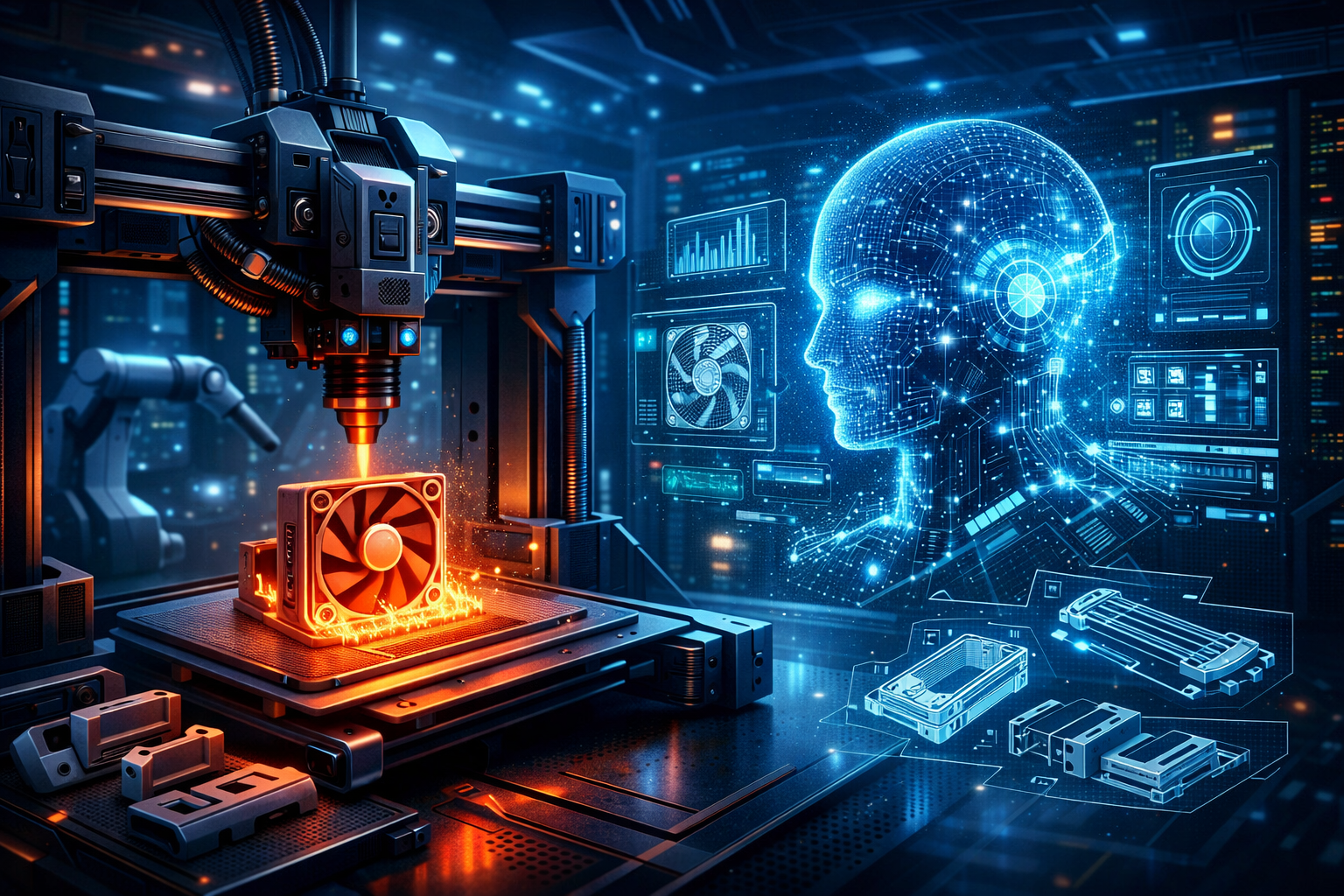
Why the Old Ops Model Had to Go
Traditional infrastructure is slow and painfully outdated:
You’re chained to vendor timelines and useless support queues.
Replacement cycles never match real-world usage.
Stocking spare parts is basically burning money.
Even tiny datacenter fixes still require someone to physically do the thing.
That whole model is legacy and legacy just means liability.
The New Workflow: AI + 3D Printing Running Ops Like a Pro
Here’s how the new pipeline works:
1. ML predicts hardware issues before they become issues
AI constantly watches thermal drift, vibration noise, PSU variance all the subtle signals humans usually miss. It flags parts long before Grafana even twitches.
2. Automated fabrication kicks in
As soon as the failure probability crosses the threshold, the printer gets to work. It churns out:
Fan brackets
Cable clips
SSD mounts
Airflow channels
Structural supports
Emergency covers
Zero procurement loops. Zero waiting.
3. The AI doesn’t just print, it optimizes
The model runs simulations like finite-element analysis and thermal/airflow modelling. Every printed part is better than the last. Your hardware literally upgrades itself over time.
4. Install is either robotic or human with AR assist
Depending on the datacenter setup:
A robot arm installs the part, or
A technician uses AR overlays that walk them through the exact steps
No confusion. No downtime.
The Actual Wins (a.k.a. Why This Matters)
70% drop in hardware-related downtime
MTTR cut almost in half
Parts cost basically zero
Low-risk incidents become fully autonomous
Scaling during traffic surges feels like flipping a switch
Best of all? No vendor lock-in. The entire pipeline is vertically owned.
The Bigger Picture: Self-Repairing Infrastructure
This system pushes us toward something wild: datacenters that heal themselves.
AI detects the failure
AI designs the fix
AI manufactures it
AI deploys it
Humans just keep an eye on things and sip coffee.
Server management stops being a never-ending firefight and turns into a horsepower multiplier for growth.