Introduction
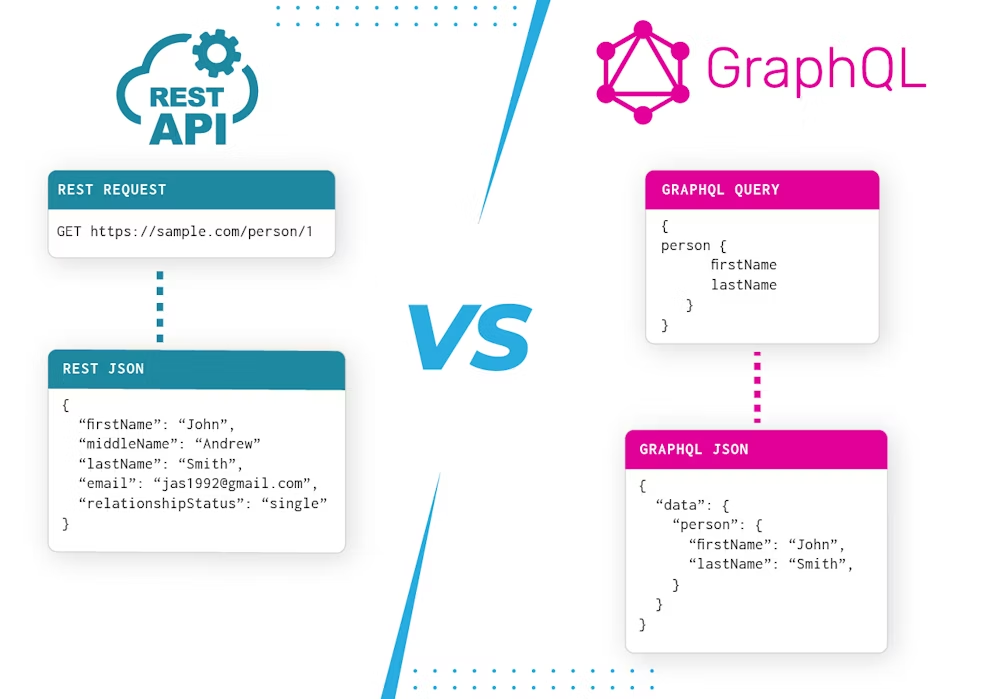
When building websites, mobile apps or any services that talk to a server, your application needs a way to fetch or update data. In tech‐speak this is done via an API (Application Programming Interface). But there’s more than one way to build an API. Two of the most popular approaches today are REST and GraphQL.
In this post we’ll explain what each is, what their strengths and weaknesses are — and how to pick the right one for your project. No heavy jargon, promise.
What is REST?
REST stands for Representational State Transfer. It’s not a protocol but an architectural style for building web services.
The basic idea: you expose resources (like users, posts, products) at distinct endpoints (URLs), and you manipulate them using standard HTTP methods like GET (read), POST (create), PUT/PATCH (update), DELETE (remove).
Example:
GET /users/123→ fetch user with ID 123POST /users→ create a new userPUT /users/123→ update user 123DELETE /users/123→ delete user 123
REST has been around for many years and is well-understood, widely supported, with lots of tools, libraries, and patterns.
When REST is a good fit:
Your data model is fairly stable and simple.
The clients (apps/browsers) need fairly straightforward data, not huge nested or highly relational queries.
You care about caching (browsers/proxies caching GET responses).
You have a team comfortable with REST tools and patterns.
What is GraphQL?
GraphQL was developed (by Facebook) and open-sourced later. It’s a query language and runtime for APIs.
Unlike REST which uses many endpoints, GraphQL generally uses a single endpoint (e.g.,
/graphql) where the client sends a query stating exactly which fields it wants, and the server returns exactly that data. Example query: { user(id:"123") { name posts { id title } } }That says: “Give me user 123’s name and their posts (IDs + titles)”.
GraphQL is very flexible, especially when you have nested/related data or when clients have widely varying needs.
When GraphQL shines:
You have many different clients (mobile apps, web, IoT) that need different subsets of data.
The data relationships are complex (e.g., users → orders → products → reviews).
You want to reduce “round-trips” (many endpoints calls) and over-fetching of unneeded data.
You’re okay investing some extra effort for schema, tooling and handling some complexity.
REST vs GraphQL: Compare Side-by-Side
So… Which Should You Choose?
It really depends on what you’re building. Here are some practical questions to ask:
How complex are your data relationships?
If your data is mostly flat and you don’t have many nested relationships, REST is probably fine.
If you have many nested relations (e.g., user→posts→comments→likes) and many clients needing different slices, GraphQL may be better.
Do clients need different subsets of data?
If most clients ask for the same data, REST is simple and efficient.
If mobile might need only a few fields, web another set, GraphQL’s flexibility wins.
How important is caching / performance of many clients?
If you rely heavily on HTTP caching (e.g., browser, proxies), REST has an edge.
If you’re okay designing custom caching and optimizing queries, GraphQL can give richer client experiences.
Do you want to minimise backend endpoints / versioning headaches?
REST endpoints may multiply and get versioned, increasing backend maintenance.
With GraphQL you can often evolve your schema with less explicit versioning.
What’s your team’s experience?
If your team knows REST very well and you have tight deadlines, go REST.
If you have the bandwidth to learn new tools, GraphQL is a strong choice for the future.
Real-World Example
Let’s imagine you’re building a blog platform:
Using REST
You might have endpoints:
GET /users/123→ user infoGET /users/123/posts→ their postsGET /posts/456/comments→ comments for a post
If a mobile client needs user name, post titles, first comment, you may need 3+ requests and you might get more data than needed.
Using GraphQL
You define a query: { user(id:"123") { name posts { title comments { author { name } content } } } }
Client gets exactly what it asked for: name, post titles, comment authors & content — in one go.
Pros & Cons Summary
Pros of REST
Simpler to understand and implement (especially for straightforward use cases).
Works well with standard HTTP methods and caching.
Mature ecosystem, many tutorials, patterns.
Cons of REST
May lead to over-fetching or under-fetching data.
Many endpoints and versions can become messy.
Less flexible for clients with widely varying data needs.
Pros of GraphQL
Clients request just the data they need — more efficient.
One endpoint, so backend endpoints don’t explode.
Great for front‐end flexibility and evolving data needs.
Cons of GraphQL
Slightly more complex to set up: schema, resolvers, tools.
Standard HTTP caching is harder; must think about caching strategy.
If over-used, clients could make very heavy queries (need safeguards).
My Recommendation (For Your Blog Audience)
Since you will publish this on your blogging website and likely address developers or tech-aware readers, here’s how you can frame it:
If you’re starting a small project, or building something with fairly simple data, and you want speed and ease → choose REST.
If your project is bigger, has many different clients (web, mobile, maybe third-party), complex data needs, or you anticipate evolving requirements → go with GraphQL.
Remember: it’s not always one or the other. Some systems use both: REST for simple parts, GraphQL for complex ones.
Highlight that understanding trade-offs is more valuable than picking a “trend”.
Conclusion
APIs are the backbone of modern apps. Getting the design right early saves headaches later.
Use REST if you value simplicity, caching and your data model is stable.
Use GraphQL if you need flexibility, efficiency and expect your data needs / client demands to evolve.